Events

  • 17.-18. September 2026: Tagung „Vermittelte Mobilität. Fahrradmedien, Kollektive und Infrastrukturen in Bewegung“

    Tagung des Forschungsprojekts „Fahrradmedien. Kooperative Medien der Mobilität“, SFB „Medien der Kooperation“

    Mobilität ist ein kooperativer Prozess, der durch vielfältige mediale, soziale und infrastrukturelle Praktiken hervorgebracht wird. So bezeichnet auch Fahrradfahren nicht nur einen Bewegungsmoment, sondern ein Zusammenspiel von Technologien, Infrastrukturen, Körpern, Bildern und Öffentlichkeiten. Zugleich ist Fahrradmobilität nicht neutral: Sie ist geprägt von gesellschaftlichen Machtverhältnissen und unterschiedlichen Erfahrungswelten.

    Vor diesem Hintergrund untersucht die Jahrestagung des Forschungsprojekts „Fahrradmedien – kooperative Praktiken der Mobilität“ (SFB 1187 „Medien der Kooperation“) das Fahrrad selbst als Medium von Öffentlichkeit und Teilhabe: als eine Mobilitätsform, die Menschen, Orte, Perspektiven und Wissen miteinander verbindet und dabei spezifische soziale und kulturelle Praktiken hervorbringt. Ausgangspunkt ist ein erweiterter Medienbegriff, der nicht nur audiovisuelle und digitale Formate umfasst, sondern auch (Sorge-)Praktiken wie Reparatur, Aktivismus oder kollektives Fahren als Formen der Vermittlung versteht.

    Wir laden herzlich zur Teilnahme und Diskussion ein. Wir bitten um eine Anmeldung per E-Mail
    Weitere Informationen und Updates zur Tagung finden Sie hier.

    Konzeption und Organisation: Julia Bee und Hannah Schmedes

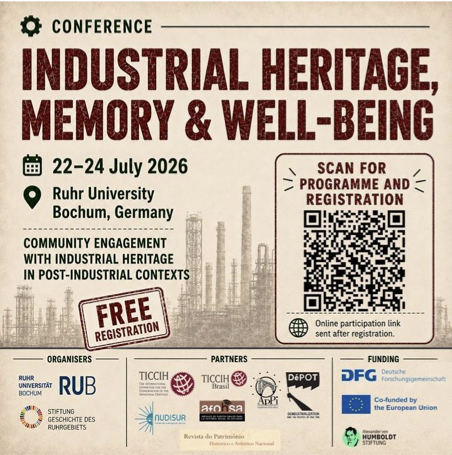
  • Conference „Industrial Heritage, Memory and Well-being – Community Engagement with Industrial Heritage in Post-industrial Contexts“, Bochum 22. – 24. 7. 2026

    This conference provides a timely platform for interdisciplinary dialogue on the cultural, social, and political legacies of industrial heritage. We aim to deepen understandings of how these histories entangle with collective memory and community well-being. The event foregrounds decolonial, community-based approaches that redefine industrial sites as terrains of resistance, remembrance, and situated knowledge. By fostering comparative and transregional analysis, the conference champions methodological innovation and historical depth. Ultimately, our goal is to drive more inclusive, participatory, and critically engaged heritage practices that address pressing contemporary societal challenges.

    22-24 July 2026 (CEST time zone — Central European Summer Time

    Format: Online and in person

    Interested participants can register through this link, after which we will send the access details for the event. The conference will be streamed online, and the regularly updated programme can be viewed here

    Venue: Institute for Social Movements, Ruhr University Bochum.
    Clemensstr. 17-19, 44789, Bochum

    Organisation Contacts:
    – Guilherme Pozzer: Guilherme.Pozzer@ruhr-uni-bochum.de
    – María Esperanza Rock-Núñez: Maria.RockNunez@ruhr-uni-bochum.de

  • 26.-27.6.2026: Workshop „Race/Genre as Infrastructure“

    More information here.

    With: Esther Adeyemo, Tomaz Amorim, Laura Bieger, Farai Chipato, Dominic Davis, Natalie Erkel, Lee Flamand, Henry Ivry, Mark Jerng, Claas Oberstadt, Kerstin Schmidt, Susan Zieger

    Attendance is free of charge. If you want to attend, please send an email to: Hildegard.Sicking@ruhr-uni-bochum.de.

    Friday, June 26

    9:00     

    Opening 

    9:15-11:00

    Session 1 – Chair: Esther Adeyemo

    Laura Bieger (RUB): Genre as Infrastructure and the Specter of Race.
    Tomaz Amorim (RUB): Names of Peoples, Names of Places: Extractivism and Race in Euclides da Cunha and Oswald de Andrade.

    11:00-11:30

    Coffee

    11:30-1:00

    Session 2 – Chair: Natalie Erkel

    Susan Zieger (UC Riverside): Suspense, Explosivity, and the Logistical Labor of Racial Capitalism in Sorcerer (1977).

    Claas Oberstadt (HU Berlin): Infrastructures of Slavery: Credit, Information, and Insurance.

    1:00-2:00 

    Lunch

    2:00-3:30

    Session 3 – Chair: Laura Bieger 

    Mark Jerng (UC Davis): Incorporating Race: Cyberpunk, Multinational Corporations, and Legal Infrastructures of Personhood.

    Esther Adeyemo (RUB): The Aesthetics of Racial Legibility in Nella Larsen’s Passing (1929).

    3:30-4:00

    Coffee 

    4:00-5:30

    Session 4  – Chair: Lee Flamand

    Henry Ivry (University of Glasgow): Listening to Infrastructure: Black Musics, Contrapuntal Genres.

    Kerstin Schmidt (LMU): Shipping Blackness: World-Making on the Stage.

    7:30

    Conference Dinner

    Saturday, June 27

    9:00-10:45

    Session 5 – Chair: Tomaz Amorim

    Lee Flamand (RUB): After-the-End-of-the-Worlding: Trans-genetic Infrastructures, Genre Hybridity, and Afrofuturist Post-humanism in Octavia Butler’s Xenogenesis novels.

    Farai Chipato (University of Glasgow): Black Geographies and the Infrastructure Humanities.

    10:45-11:15

    Coffee

    11:15-12:45

    Session 6 – Chair: Esther Adeyemo

    Natalie Erkel (RUB): Martin Delaney and the Republic of New Afrika: Infrastructuring a Black Nation-State.

    Dom Davies (City St George’s, University of London): Plumbing the Nation: Hotels, Drains, Borders, Britain, and the Racialised Politics of Blockage and Flow.

    12:45-1:45

    Lunch & Wrap-Up

    Afternoon

    Infrastructure Tour: Bochum Westpark & Jahrhunderthalle and Essen Zeche Zollverein

    Meeting Point: 2:30 p.m. at Entrance to Westpark next to IG Metall Building, Alleestr. 80, 44793 Bochum

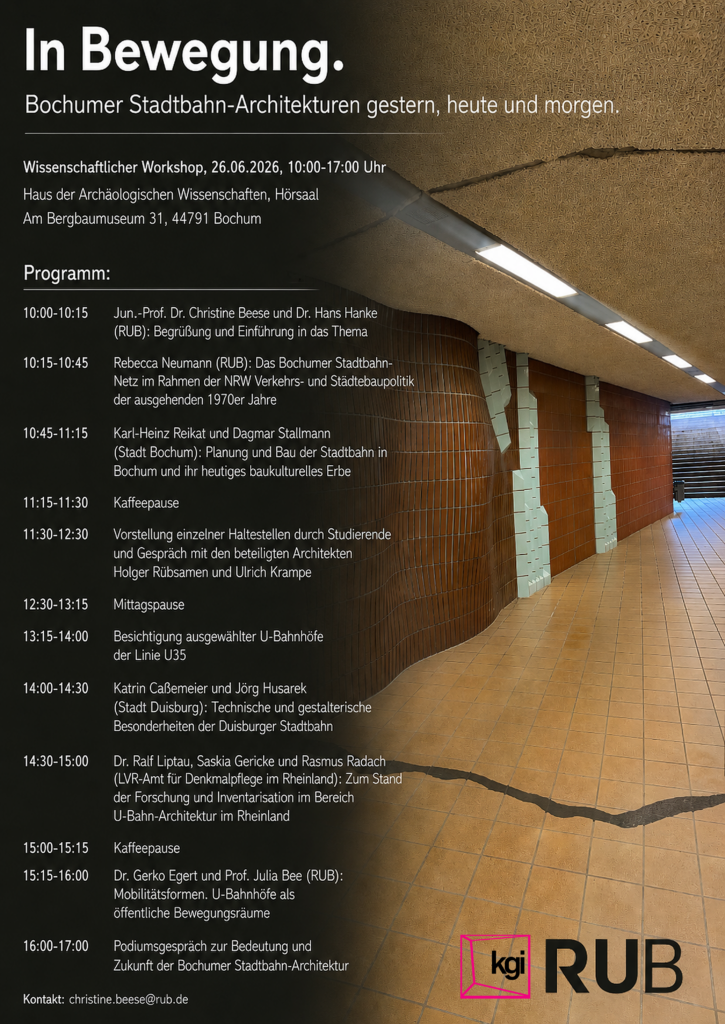
  • 26.6.2026: Workshop „In Bewegung. Bochumer Stadtbahn-Architekturen gestern, heute und morgen“

    More information here.

    In Bewegung. Bochumer Stadtbahn-Architekturen gestern, heute und morgen.

    Wissenschaftlicher Workshop, 26.06.2026, 10:00-17:00 Uhr
    Haus der Archäologischen Wissenschaften, Hörsaal
    Am Bergbaumuseum 31, 44791 Bochum

    Kontakt: Christine.Beese@rub.de

    Programm:

    10:00-10:15 Jun.-Prof. Dr. Christine Beese und Dr. Hans Hanke (RUB): Begrüßung und Einführung in das Thema

    10:15-10:45 Rebecca Neumann (RUB): Das Bochumer Stadtbahn-Netz im Rahmen der NRW Verkehrs- und Städtebaupolitik der ausgehenden 1970er Jahre

    10:45-11:15 Karl-Heinz Reikat und Dagmar Stallmann (Stadt Bochum): Planung und Bau der Stadtbahn in Bochum und ihr heutiges baukulturelles Erbe

    11:15-11:30 Kaffeepause

    11:30-12:30 Vorstellung einzelner Haltestellen durch Studierende und Gespräch mit den beteiligten Architekten Holger Rübsamen und Ulrich Krampe

    12:30-13:15 Mittagspause

    13:15-14:00 Besichtigung ausgewählter U-Bahnhöfe der Linie U35

    14:00-14:30 Katrin Caßemeier und Jörg Husarek (Stadt Duisburg): Technische und gestalterische Besonderheiten der Duisburger Stadtbahn

    14:30-15:00 Dr. Ralf Liptau, Saskia Gericke und Rasmus Radach (LVR-Amt für Denkmalpflege im Rheinland): Zum Stand der Forschung und Inventarisation im Bereich U-Bahn-Architektur im Rheinland

    15:00-15:15 Kaffeepause

    15:15-16:00 PD Dr. Gerko Egert und Prof. Dr. Julia Bee (RUB): Mobilitätsformen. U-Bahnhöfe als öffentliche Bewegungsräume

    16:00-17:00 Podiumsgespräch zur Bedeutung und Zukunft der Bochumer Stadtbahn-Architektur